TELEGRAM_CRAWLER
A scalable and fault-tolerant Telegram data-collection infrastructure built with Telethon for asynchronous crawling, incremental synchronization, normalization, and searchable indexing.
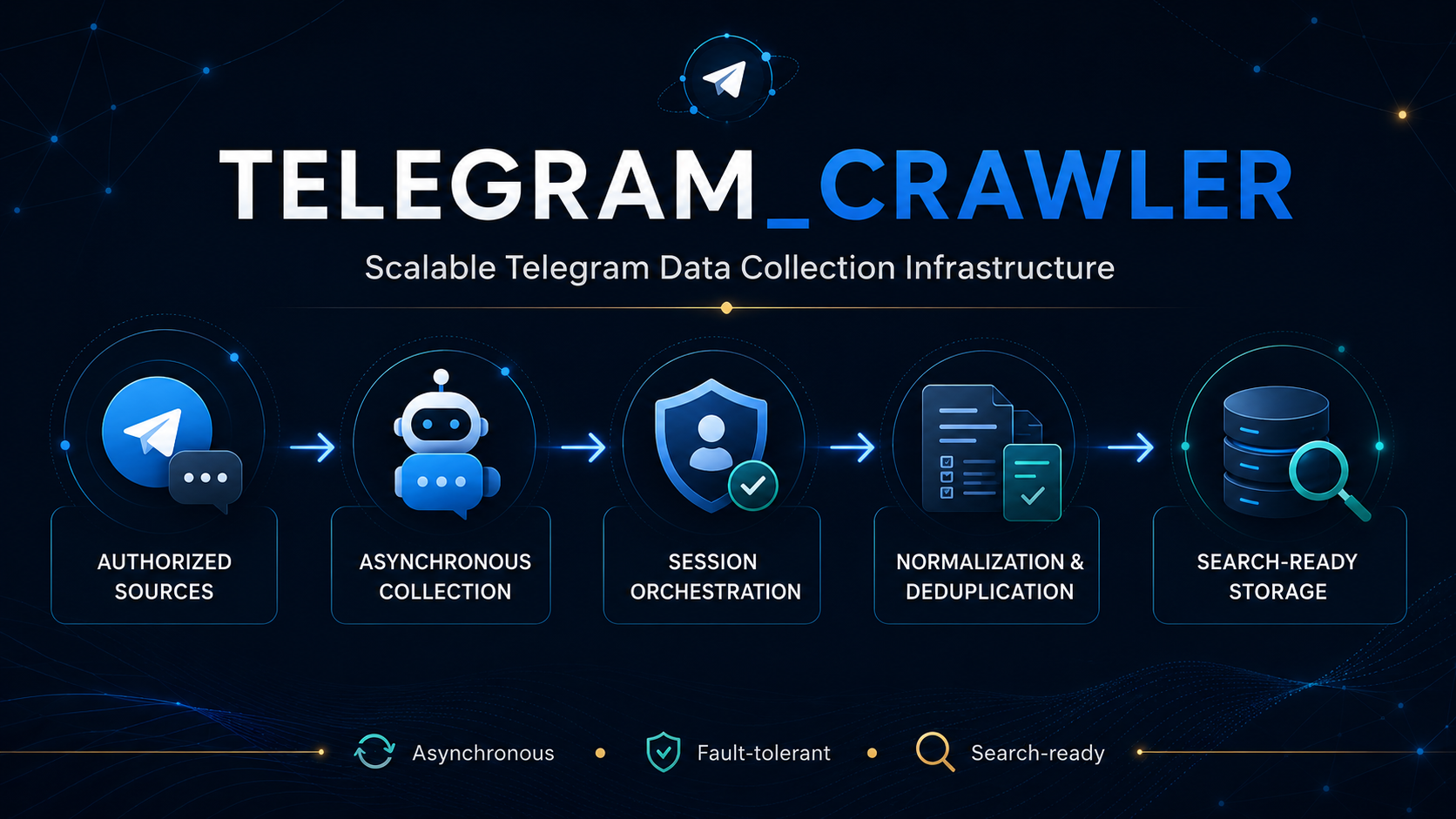
Overview
TELEGRAM_CRAWLER is a scalable data-collection and indexing infrastructure designed to acquire, normalize, and maintain large historical and continuously updated Telegram datasets.
The system is implemented in Python using Telethon and an asynchronous worker architecture. It supports controlled collection from authorized public or otherwise permitted sources while maintaining operational reliability under long-running workloads, network interruptions, variable source activity, and platform-level constraints.
Rather than functioning as a single scraping script, the project was designed as a complete data-engineering system containing:
- task scheduling,
- session orchestration,
- asynchronous worker execution,
- incremental synchronization,
- persistent checkpoints,
- retry and backoff control,
- schema normalization,
- duplicate prevention,
- searchable indexing,
- and operational monitoring.
The public portfolio intentionally focuses on architecture and engineering capability rather than exposing exact collection volumes, session counts, internal thresholds, or infrastructure-specific configuration.
Asynchronous
Concurrent collection without blocking the complete pipelineIncremental
Only new or changed records are synchronized after each checkpointFault-tolerant
Interrupted jobs can resume without restarting the entire collectionSearch-ready
Normalized records are prepared for indexing and analytical retrievalThe Engineering Challenge
Collecting social-platform data reliably at scale is fundamentally different from downloading a small number of pages.
A production collection system must operate continuously while handling:
- sources with very different activity levels,
- long message histories,
- temporary network failures,
- deleted or inaccessible records,
- changing metadata,
- duplicate events,
- interrupted workers,
- platform-imposed request constraints,
- and downstream indexing pressure.
A naive implementation may repeatedly download the same content, lose progress when a worker stops, overload storage, or silently skip records.
TELEGRAM_CRAWLER addresses these problems through a stateful, distributed, and recoverable architecture.
High-level Architecture
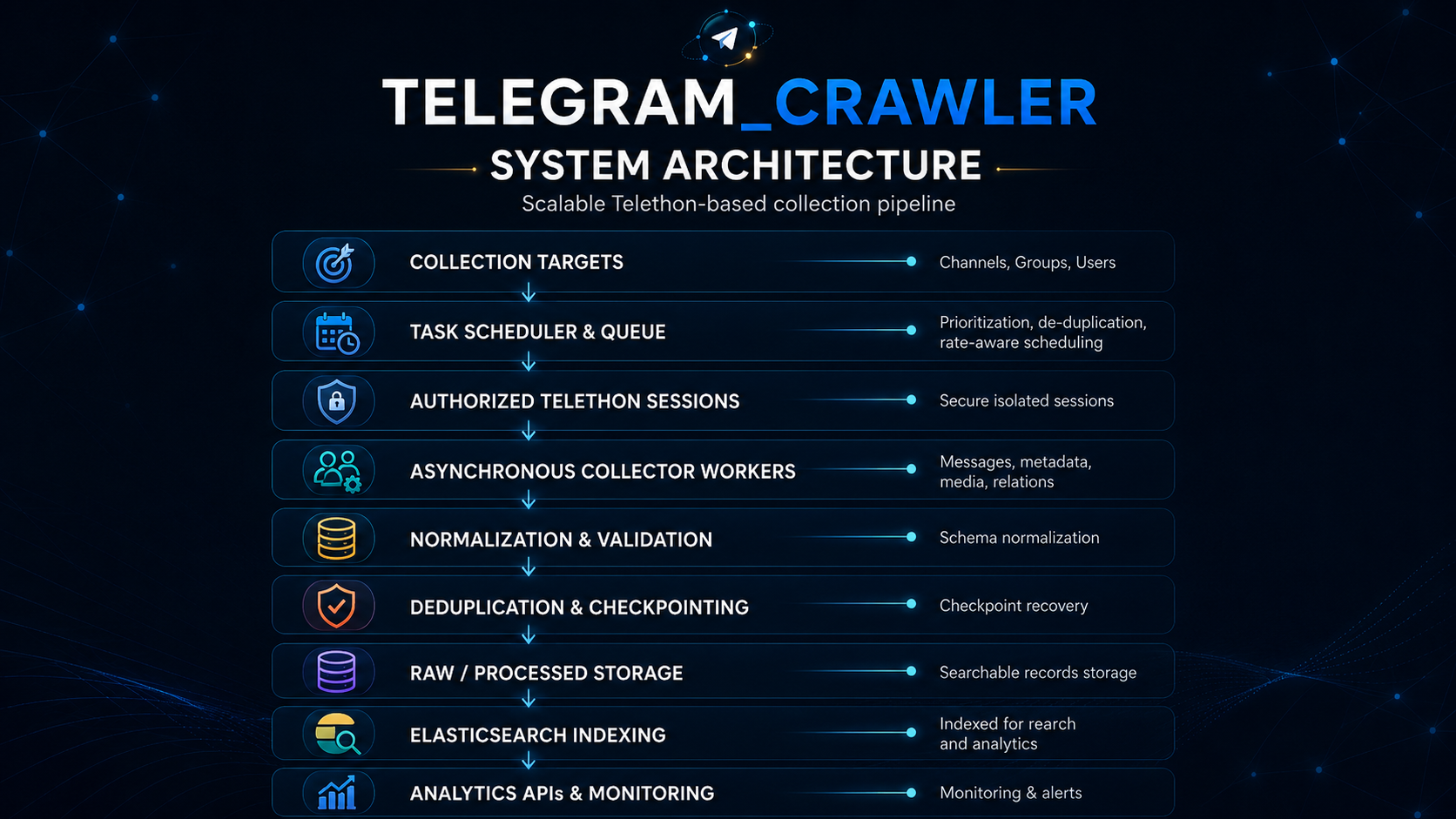
The platform is divided into several independent layers.
Collection-target Management
Authorized collection targets are registered with metadata describing:
- source identifier,
- collection status,
- synchronization policy,
- previous checkpoint,
- priority,
- and permitted data types.
The system does not rely on hard-coded channel lists inside worker processes.
Task Scheduler
The scheduler converts collection targets into executable tasks.
Its responsibilities include:
- prioritizing pending sources,
- preventing duplicate concurrent jobs,
- delaying temporarily unavailable sources,
- distributing tasks between workers,
- and rescheduling incomplete work.
Telethon Session Layer
The collection layer uses Telethon clients through isolated, authorized sessions.
Session management is separated from crawling logic so that workers can:
- obtain a healthy client,
- report session failures,
- release resources after completion,
- and avoid embedding credentials inside task definitions.
The public implementation description intentionally excludes operational session counts, authentication details, and credential-management configuration.
Asynchronous Workers
Workers perform network-bound collection asynchronously.
They can process multiple independent tasks while waiting for network responses, improving resource utilization compared with a sequential collector.
Each worker follows the same controlled lifecycle:
- obtain a task,
- load the previous checkpoint,
- retrieve permitted records,
- normalize and validate each record,
- persist progress,
- forward accepted records for indexing,
- and report completion or recoverable failure.
Processing and Storage
Raw Telegram objects are converted into a consistent internal schema before storage.
This prevents downstream services from depending directly on Telethon-specific object structures.
Indexing and Serving
Normalized records are indexed in Elasticsearch and exposed through analytical APIs.
The surrounding infrastructure supports large historical collections and high-throughput search, aggregation, user profiling, and trend-analysis workloads.
Collection Lifecycle
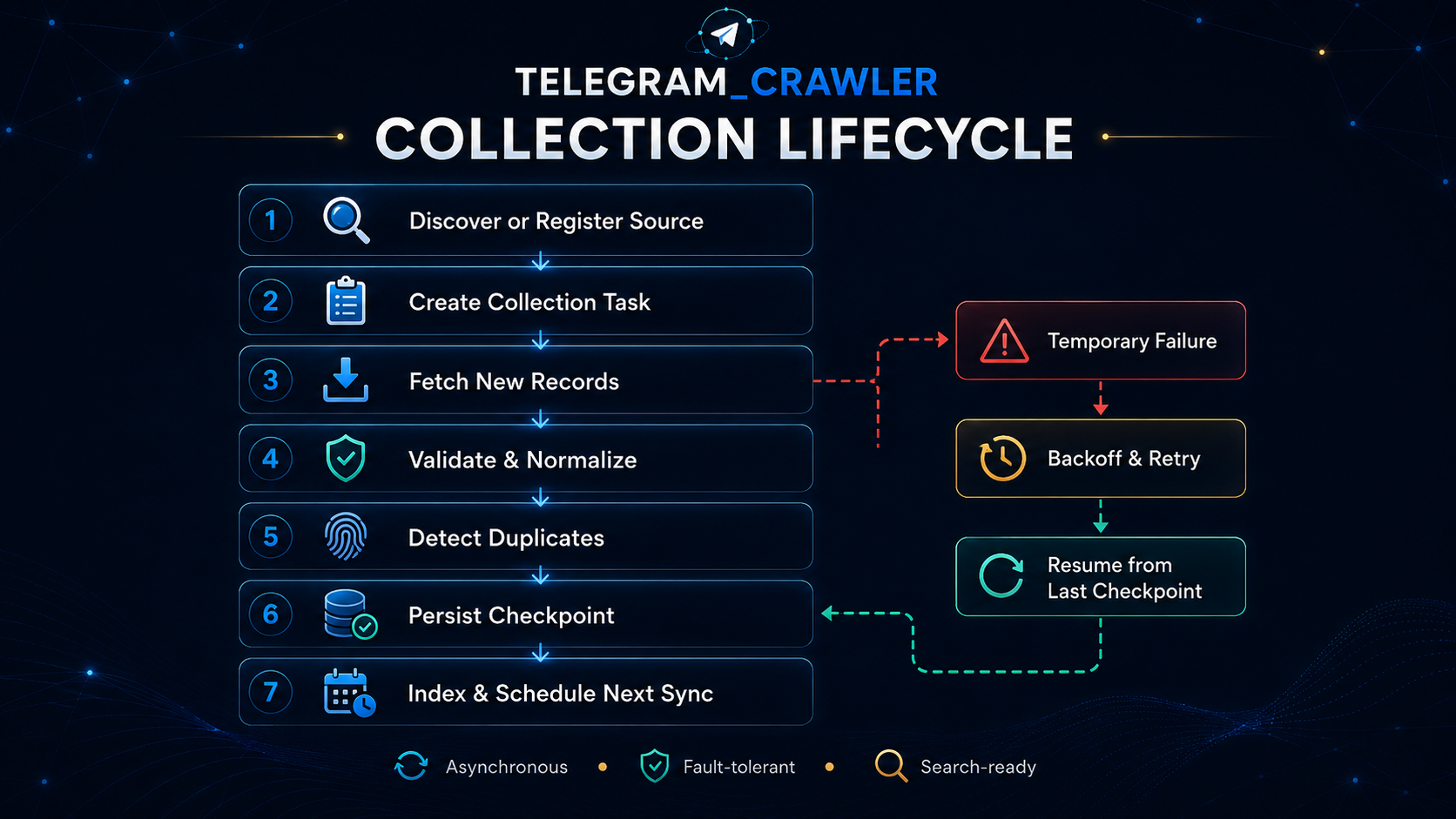
Each collection task progresses through a controlled lifecycle.
1. Source Registration
A source is added only after its collection scope and authorization have been established.
The registration record stores the information required to schedule future synchronization without exposing credentials to the worker queue.
2. Checkpoint Loading
Before requesting records, the worker loads the most recent successfully persisted state.
Depending on the source and collection mode, the checkpoint may represent:
- the newest processed message,
- the oldest completed historical segment,
- a pagination cursor,
- or a time-based synchronization boundary.
3. Incremental Retrieval
The worker retrieves only the portion of the source that has not already been processed.
Incremental synchronization reduces:
- unnecessary network requests,
- duplicate processing,
- storage overhead,
- and index-update cost.
4. Validation and Normalization
Retrieved objects are checked for structural validity and transformed into the project’s internal schema.
5. Deduplication
Stable identifiers and source-aware keys are used to prevent duplicate records when:
- jobs are retried,
- workers restart,
- checkpoints overlap,
- or a source is synchronized from multiple processing stages.
6. Checkpoint Persistence
Progress is persisted in small, recoverable increments.
A worker failure therefore affects only the unfinished portion of a task rather than invalidating the entire collection process.
7. Rescheduling
After successful synchronization, the source is scheduled according to its expected update frequency and operational priority.
Collected Data Model
Depending on source permissions and project requirements, the normalized model can represent:
- message text,
- source and message identifiers,
- publication timestamps,
- edits and deletion state,
- reply relationships,
- forward metadata,
- media metadata,
- extracted entities,
- view and interaction counters,
- source metadata,
- and collection provenance.
The schema distinguishes between:
- information directly observed from the source,
- metadata generated during collection,
- and features produced later by NLP or analytical services.
This separation improves traceability and simplifies reprocessing.
Reliability and Observability
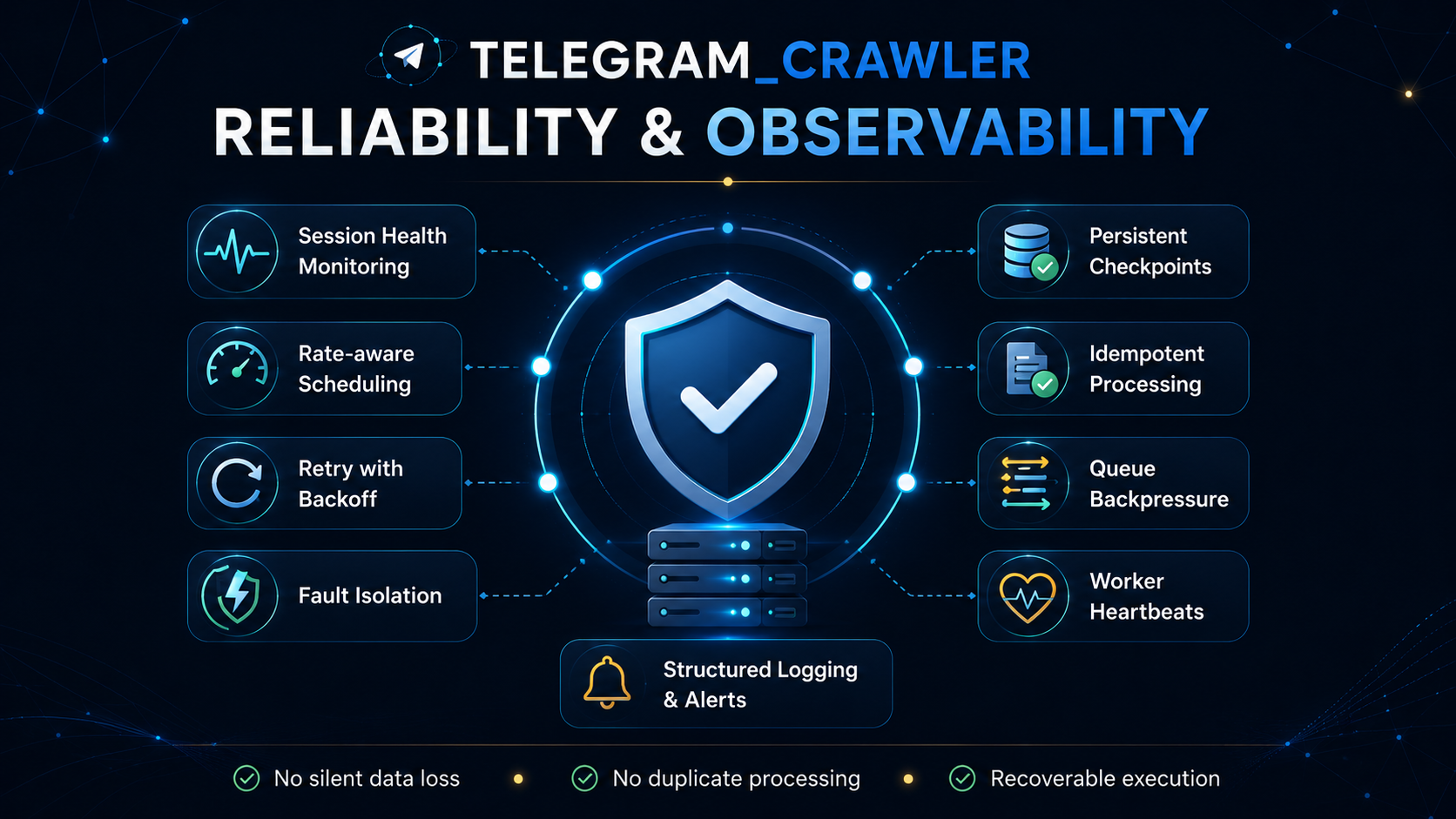
Reliability is implemented at several levels.
Retry with Controlled Backoff
Temporary failures are retried using increasing delays rather than immediate repeated requests.
Permanent and temporary failures are classified differently so that invalid sources do not remain in an endless retry loop.
Rate-aware Scheduling
The scheduler accounts for platform feedback and temporary availability constraints.
The objective is stable and compliant execution, not circumvention of platform restrictions.
Fault Isolation
A failure in one source or session does not stop unrelated collection tasks.
Tasks are processed independently, and failures are recorded with enough context for later inspection.
Persistent Checkpoints
Checkpoints allow workers to resume collection after:
- process restarts,
- server maintenance,
- temporary network loss,
- and controlled deployment updates.
Idempotent Processing
Repeated processing of the same event produces the same final record rather than creating duplicates.
Backpressure
When storage or indexing components slow down, the collection layer reduces intake instead of accumulating an uncontrolled in-memory backlog.
Monitoring
Operational monitoring can cover:
- active and idle workers,
- queued tasks,
- recent completions,
- retries,
- source-level failures,
- indexing latency,
- checkpoint age,
- and session health.
Sensitive identifiers and authentication material are excluded from public dashboards.
Indexing Pipeline
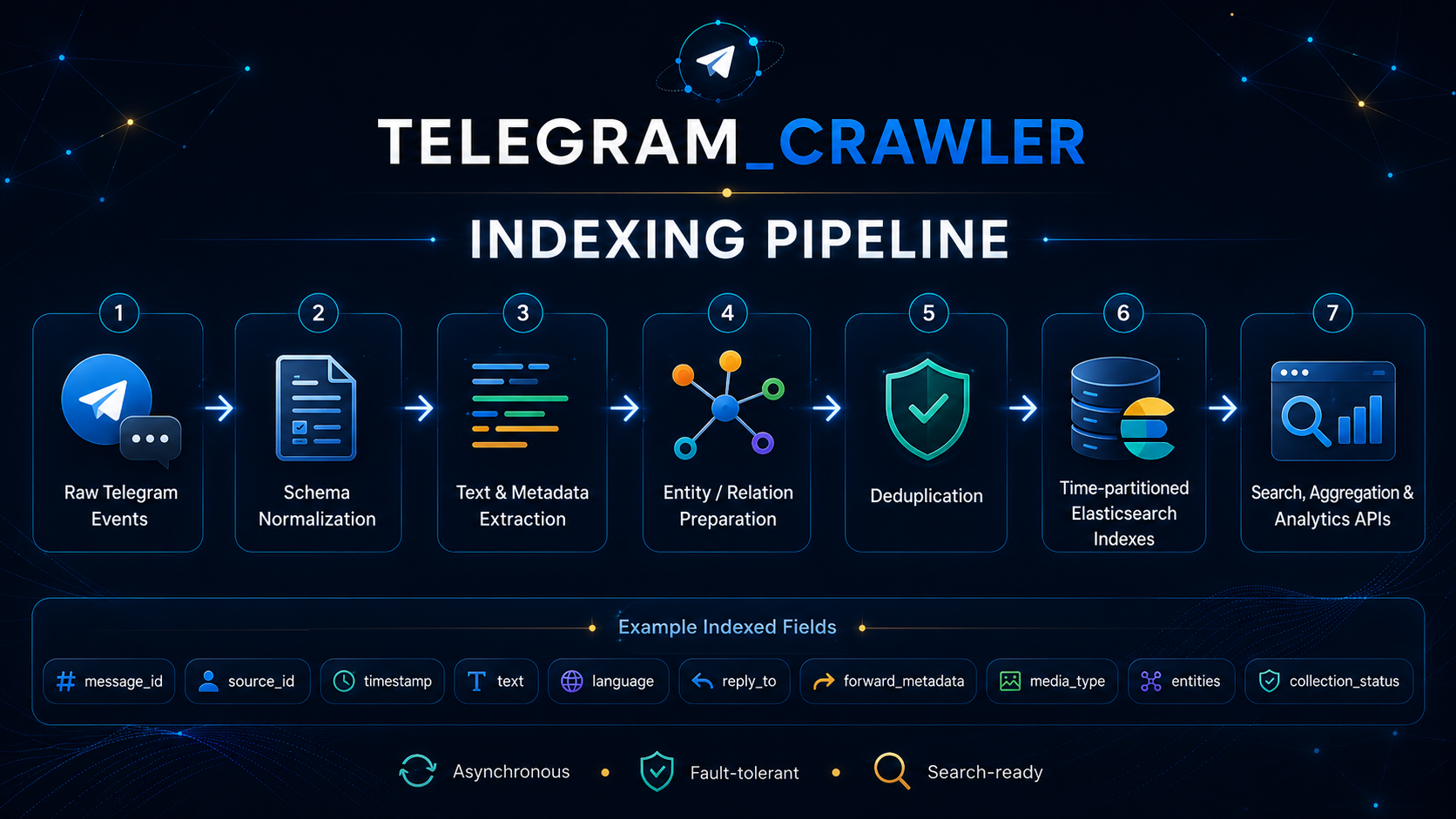
Raw Telegram objects are not inserted directly into the analytical index.
The indexing pipeline performs:
- schema conversion,
- text normalization,
- timestamp standardization,
- entity and metadata extraction,
- duplicate detection,
- source and provenance attachment,
- index routing,
- and controlled bulk indexing.
Search-oriented mappings are designed according to query requirements rather than mirroring the source API objects.
The index can support operations such as:
- full-text search,
- time-range filtering,
- source-level aggregation,
- language filtering,
- relationship analysis,
- trend extraction,
- user profiling,
- and downstream NLP processing.
Scaling Strategy
The system scales horizontally by separating collection state from worker processes.
Additional workers can be introduced without requiring the complete source list to be divided manually.
The main scaling principles include:
- stateless or minimally stateful workers,
- centralized task coordination,
- persistent checkpoints,
- independently scalable indexing,
- batch-oriented database operations,
- and source-aware partitioning.
The project demonstrates the ability to engineer and operate distributed Telegram data collection without publishing sensitive operational quantities.
Responsible Data Collection
The infrastructure is intended for authorized research and analytical use.
Responsible operation requires:
- collecting only public or otherwise permitted data,
- respecting platform policies and applicable law,
- avoiding access to private conversations without authorization,
- minimizing unnecessary personal-data retention,
- applying access controls to collected records,
- documenting data provenance,
- and defining retention and deletion procedures.
The system architecture does not treat technical accessibility as automatic permission for unrestricted collection.
Public Portfolio Disclosure
The public project page intentionally does not disclose:
- exact message volume,
- exact account or session count,
- phone numbers,
- session strings,
- API credentials,
- proxy or network configuration,
- internal source lists,
- Elasticsearch index names,
- server addresses,
- operational thresholds,
- or platform-specific recovery procedures.
These details are unnecessary for evaluating the engineering contribution and could expose security-sensitive operational information.
Instead, the portfolio focuses on:
- system architecture,
- asynchronous programming,
- data consistency,
- scalability,
- reliability,
- indexing,
- and production operations.
My Role
As the AI/NLP engineer and data-infrastructure lead, I contributed to:
- designing the distributed Telegram collection architecture,
- implementing asynchronous collection workflows with Telethon,
- designing task scheduling and worker coordination,
- developing persistent checkpoint and recovery mechanisms,
- implementing source-aware deduplication,
- defining normalized message and metadata schemas,
- integrating the collection layer with Elasticsearch,
- optimizing bulk and near-real-time indexing,
- implementing monitoring and failure reporting,
- coordinating production deployment,
- and preparing the collected data for downstream NLP, user-profile, and trend-analysis systems.
Technology Stack
Python · Telethon · AsyncIO · Elasticsearch · Redis · FastAPI · Docker · Kibana · Distributed Workers · Task Queues · Checkpointing · Structured Logging
Project Significance
TELEGRAM_CRAWLER demonstrates the transition from a conventional scraping script to a production-oriented data infrastructure.
Its contribution lies in combining asynchronous collection, stateful synchronization, fault recovery, duplicate-safe processing, search-oriented indexing, and operational monitoring within a scalable and maintainable architecture.